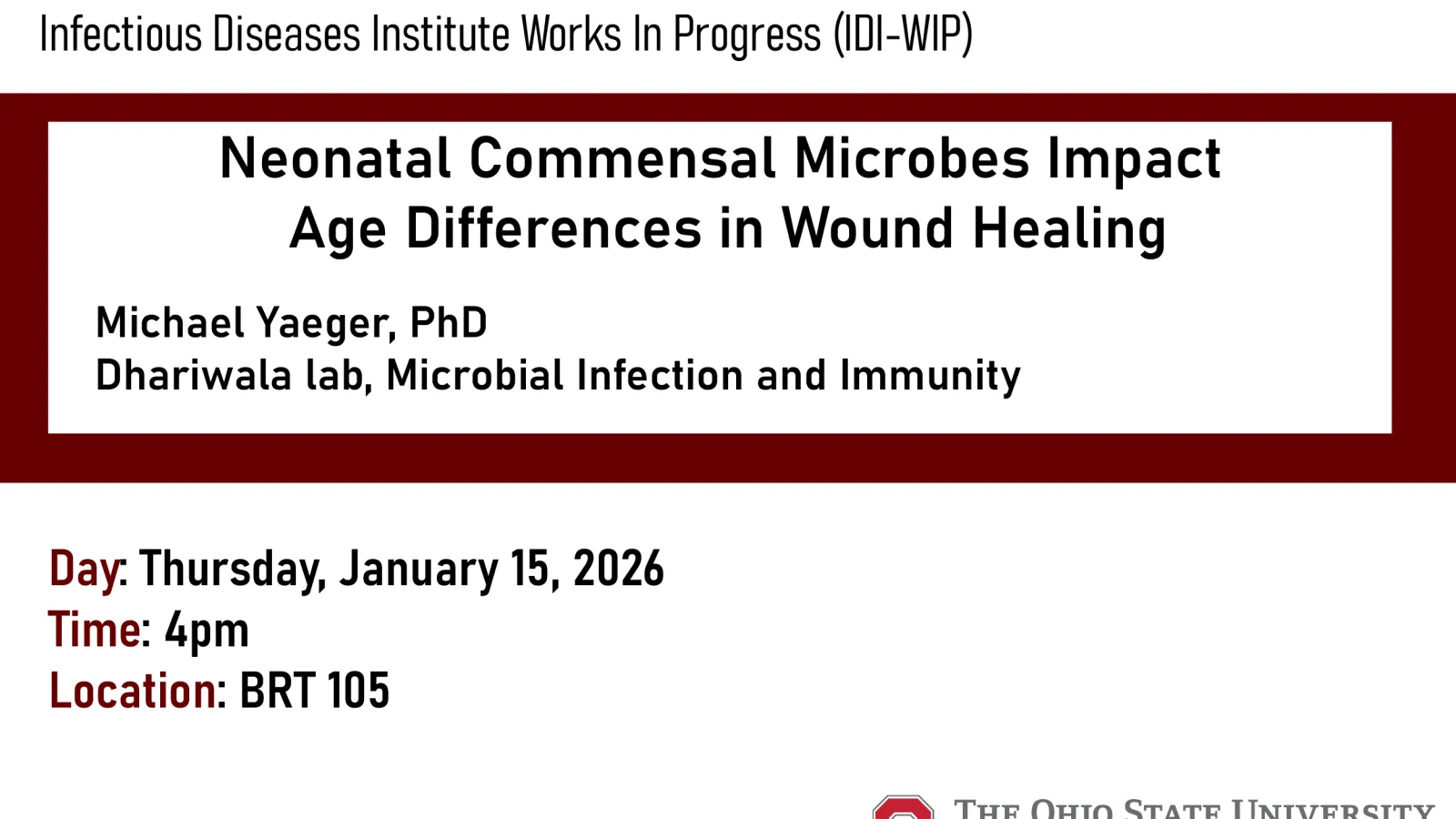
IDI-WIP Seminar - LOCATION CHANGE to BRT 105!
The presenter of the IDI WIP seminar this week is Michael Yaeger, a Post Doctoral fellow in Dr. Dhariwala’s lab at Microbial Infection and Immunity.
The title of his talk is “Neonatal Commensal Microbes Impact Age Differences in Wound Healing”.
Synopsis:
An unresolved skin wound is a dangerous condition that disproportionately impacts the elderly, affecting 5% of individuals over 80 years old compared to 2% of the general population. Recent evidence suggests commensal microbe exposure to the skin during neonatal development can have long-lasting effects that impact adulthood skin health. This is partially through commensal microbes imprinting on developing immune cells, such as macrophages. However, it is unknown if commensal microbes directly interact with neonatal macrophages or if that interaction leads to changes in wound healing. We hypothesize that commensal microbes epigenetically program neonatal skin macrophages, leading to improved wound healing capacity that persists into geriatric ages. We first identified that older mice have delayed wound healing and more macrophages that display pro-inflammatory markers compared to young mice, suggesting macrophages are a key component in age differences in wound healing. Next, we identified that commensal microbes interact with macrophages, causing increased scavenger receptors and inducing chromatin remodeling that promotes wound healing pathways. Furthermore, depletion of commensal microbes during neonatal stages led to delayed wound healing in young mice and significantly disrupted immune cell populations. These findings suggest that commensal microbes imprint on neonatal macrophages to upregulate wound healing pathways, which may impact age differences in wound healing. Future research will identify if neonatal commensal microbe exposure also impacts wound healing in older mice, and the underlying causes for these differences will be investigated. This work will help to identify causes for, and ultimately prevent, unresolved wounds in the elderly.
The seminar will take place in BRT 105 at 4pm on Thursday, January 15, 2026.